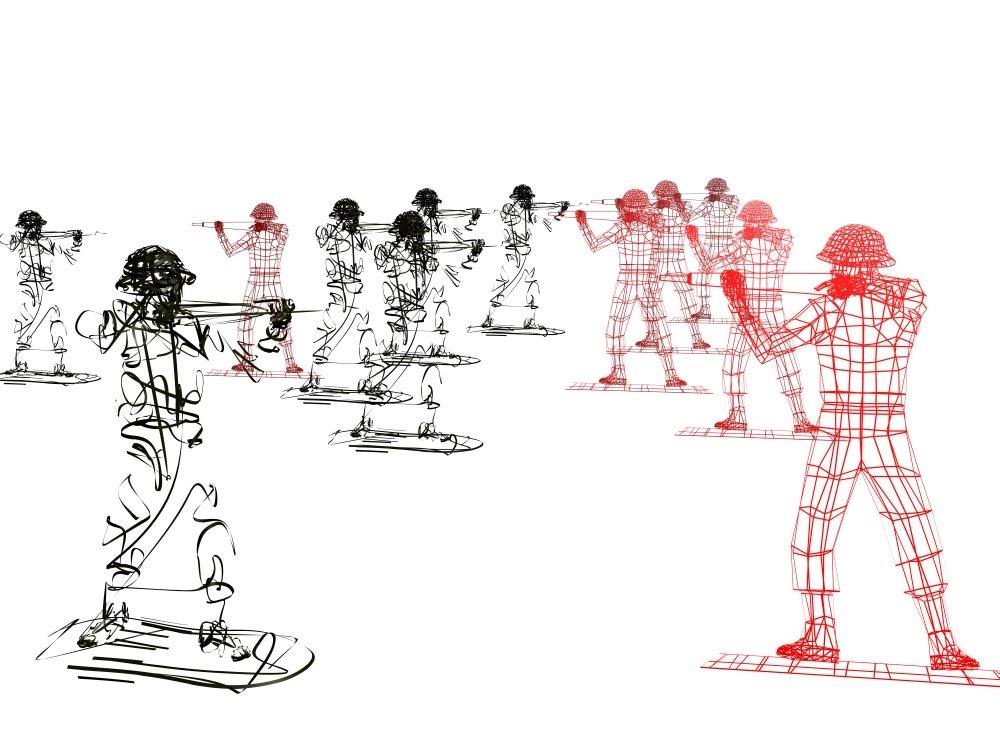
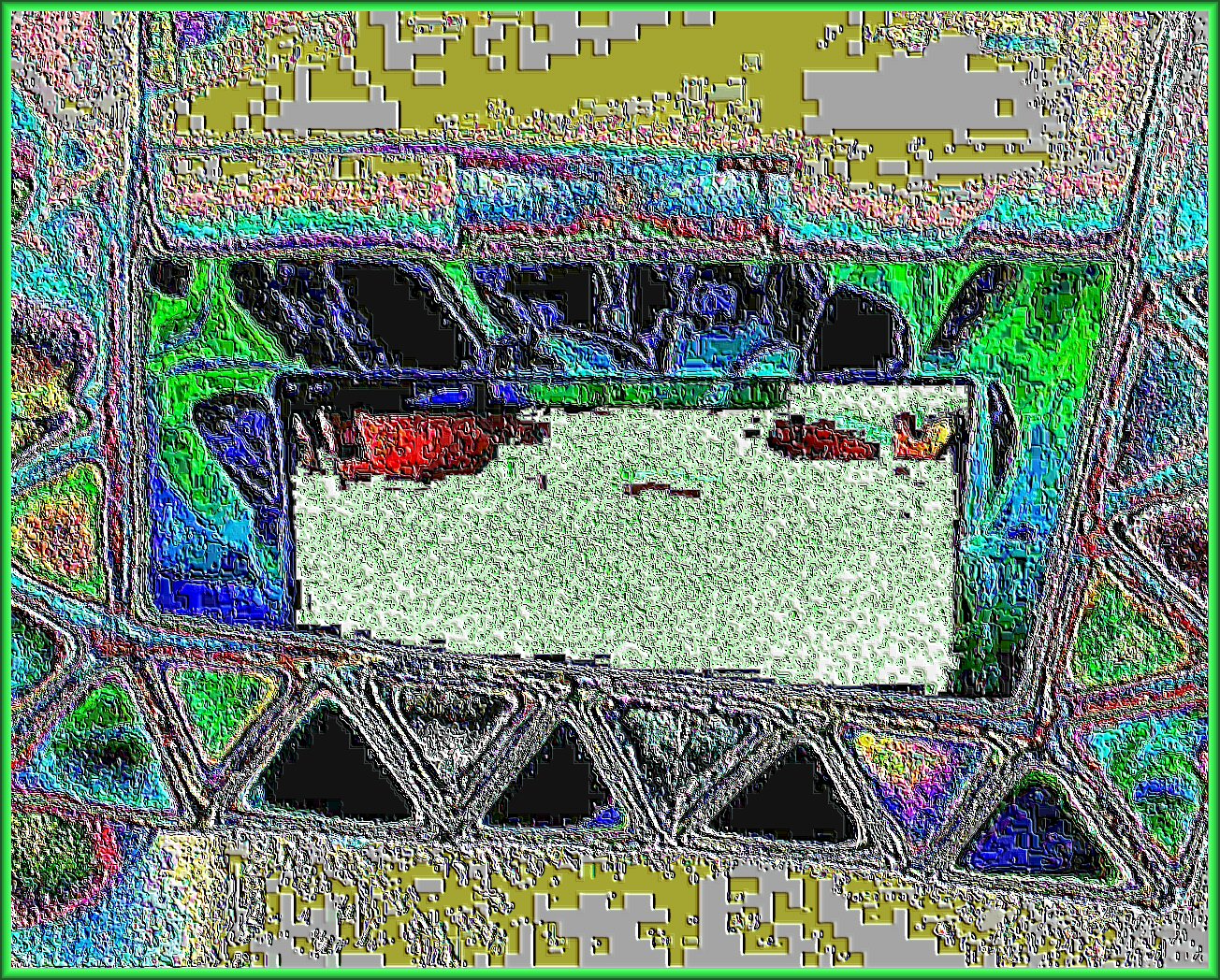
Charles Csuri Different from Us, frame 001, war16 series, 2012, Linus environment and AL
This striking new work by one of the great pioneers of computer art Charles A. Csuri, references and expands one of his original ideas Random War, a plotter drawing created in 1966. Random War (2012), is a new online version which uses gaming logics and the Internet to re-create a hypothetical war, based on our own friends, with people wounded, dead, awarded medals or missing in action, using names gleaned from our Facebook account. There is a delicious irony in using technology originally designed for defense purposes to create art that speaks to the consequences of such use. This art work is a powerful comment on the human cost of war and a stark reminder that every conflict has an after effect. Full article here: http://www.bcs.org/content/conWebDoc/44253
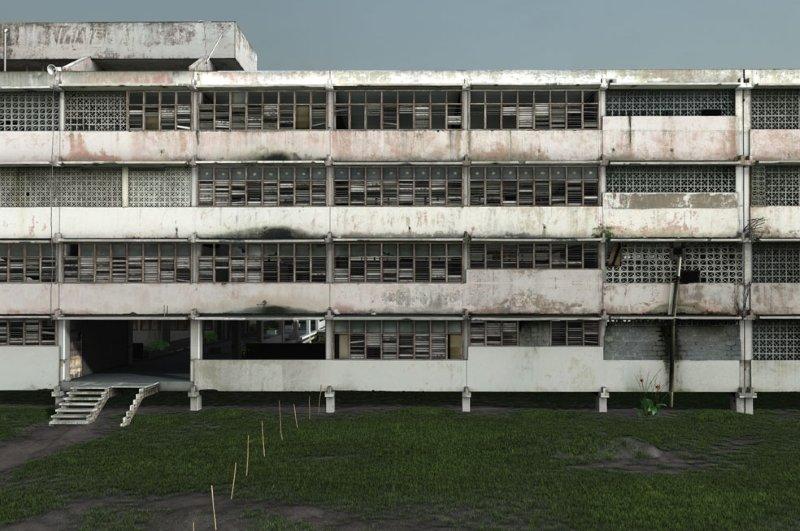
John Gerrard, Cuban School (Community of 5th October), 2010. Realtime 3D software, custom made monitor (69x115x30cm) or projection, dimensions variable. Copyright the artist. Courtesy Thomas Dane Gallery, London and Simon Preston Gallery, New York. Reproduced with permission. Collection of mima, purchased with assistance of the Art Fund supported by the Sfumato Foundation.
In our world where the digital is almost by definition associated with high speed, quick manoeuvrability and near instantaneousness, it is an inspiration to learn of John Gerrard’s deliberately slower paced work – the subject of this month’s column for the British Computer Society and premiering in March at AV Festival 12 in conjunction with Middlesbrough Institute of Modern Art. Read it here: http://www.bcs.org/content/conWebDoc/43887
David Hockney, perhaps Britain’s most famous living artist, has never been one to shy away from the use of new technology. Whilst a student at the Royal College of Art he embraced acrylic paints when they were still quite new in the 1960s and has used the photocopying machine and a Polaroid camera to create collages, exploiting the unique characteristics of each of these mediums. Recently Hockney has turned to the iPad and this month’s image, from a group called The Arrival of Spring in East Yorkshire, was made on the iPad, printed out on a large scale and is currently on show at the Royal Academy, London. Read the full article here: http://www.bcs.org/content/conWebDoc/43630 See also a related post here:http://www.spiritofplacenorfolk.org/pages/aspects.html
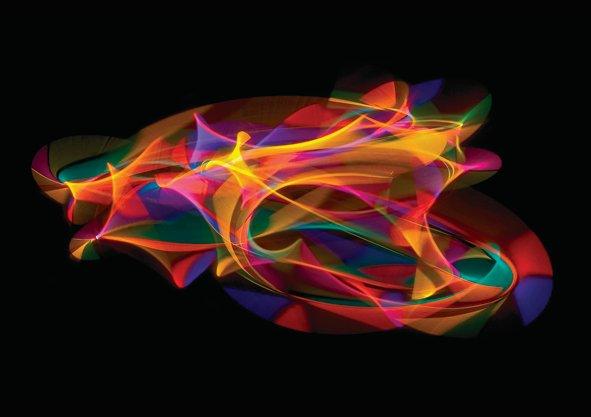
Jack Tait, Turntable light drawing 14, 2011. Taitograph, dimensions variable. Copyright the artist, reproduced with permission.
The inspiration for this month’s BCS column comes from the great conceptual artist Sol LeWitt’s statement, The idea becomes a machine that makes the art (1967). Although LeWitt’s machine was metaphorical rather than literal, nevertheless this radical concept raised questions about the notion of art process and creative behaviour and challenged the notion of what art was or could be. This month we explore the history of the use of analogue mechanical systems and machines in art through the work of Jack Tait, seen above. Read the full article here: http://www.bcs.org/content/conWebDoc/43260
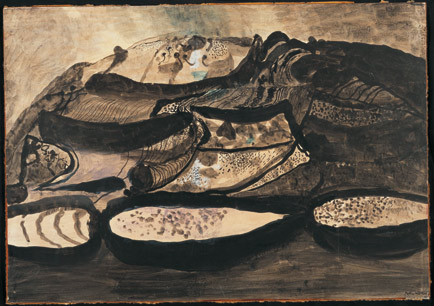
A marvellous new exhibition of around 80 pen & ink drawings, watercolours and gouaches has just opened at Modern Art Oxford. These rarely seen works on paper, borrowed from private collections and mostly regional museums (no doubt where much of it has been residing in storage for many years), demonstrate Sutherland’s almost obsessive drive to paint his subject the English and Welsh landscape, over and over again each time capturing something new a subtle change in form, or light or colour. Sutherland’s post-war thorn cross & head paintings, his giant tapestry at Coventry Cathedral are well-known, but in this show we see a quieter side to him and through careful curation are able to learn about his working methods.
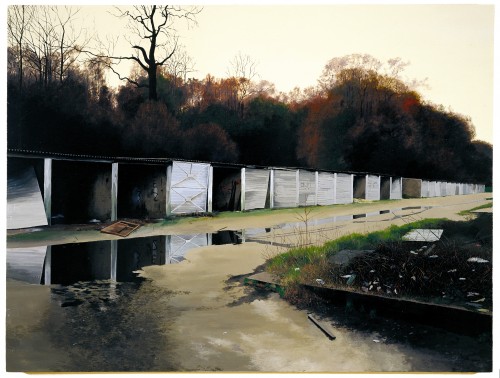
The exhibition has been selected and curated by George Shaw a painter whose own work centers on depictions of Tile Hill, a post-war council housing estate on the south side of Coventry where he grew up (and in my opinion, the artist who should have won the Turner Prize this year). By reconsidering Sutherland through this painter’s eyes we also understand more about where Shaw is coming from in his own work, which uses hobby Humbrol paints to talk about his sense of memory and loss within decaying suburbia a place with nothing but recent history. Shaw says, ‘It is not about place it is quite abstract. The painting is of how far away you are from there. It is a tethering so you know how far you’ve come.’ [quote from Daily Telegraph Review, 3/12/11, p.7]
Scenes from the Passion: The Fall, 1999, copyright George Shaw, courtesy Wilkinson Gallery, London. (From the Herbert Gallery website)
All of this raises interesting and timely debates around a sense of place. According to Shaw, Sutherland was an artist as much rooted in the past as in the world before him a world forever unfinished. Shaw’s world is also unfinished (he is now nearing his 180th painting of Tile Hill). He uses his place Tile Hill as his device on which to hang timeless painterly concerns, and so doing he tells us something of the anxieties of 21st century living.
To mark a year’s worth of writing about the world of computer arts for the British Computer Society’s on-line journal and as an end of year special, for December we are celebrating with a quartet of images submitted by readers. The four images by Alan Sutcliffe, Ursula Freer, Mark Thorpe and Nigel Williams reveal a kaleidoscopic mixture of digital technique, complexity, happenstance, experimentation and dazzling colour.
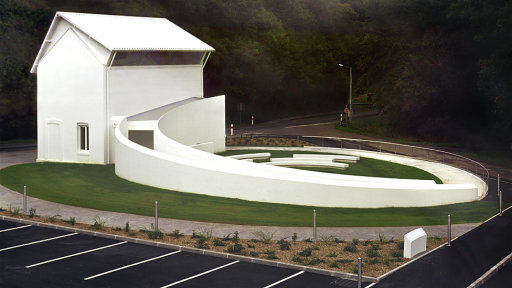
In honour of Remembrance Sunday, here is the Foresters’ House in Northern France where British poet & soldier Wilfred Owen wrote his last letter home (sheltering in the cellar) before he was killed in 1918 aged just 25. The modest farmhouse has been transformed by British artist Simon Patterson (renowned for his artwork The Great Bear, a re-working of the London Underground Map). It is certainly not a typical War memorial, rather a particularly potent example of what can happen when artists get involved with such projects. The house has become a sculpture, incorporating sound (the reading of poems & letters) and visuals (engravings of poems & text) with light.
Some (including Owen’s nephew and the W Owen Association) were initially concerned about the proposal believing that the original house would be ruined. Now, with the house transformed, they say it maintains its architectural integrity and, perhaps more importantly, has highlighted Owen’s poetry, making it more accessible. Very surprising and beautiful; moving are some of the comments from locals, heard in an excellent BBC Radio 4 documentary.
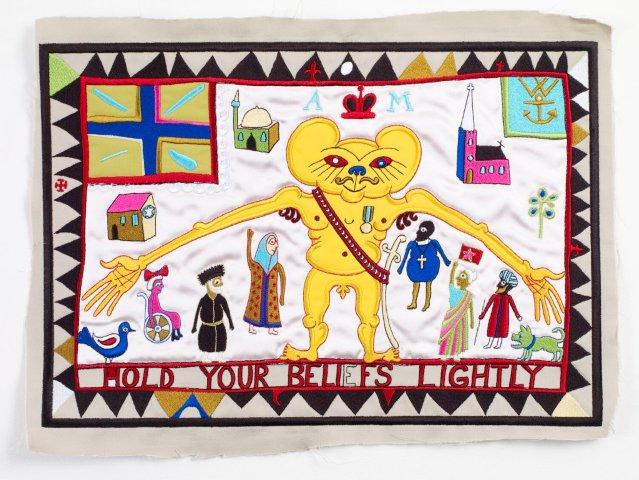
Grayson Perry, Hold Your Beliefs Lightly, 2011. Computerised embroidery on cotton and silk, programming by Tony Taylor. 32.5 x 45cm, Edition of 250 plus 10 Artist�s Proofs, copyright the artist, reproduced with permission, courtesy ofVictoria Miro
This month’s image is by Turner Prize-winning artist Grayson Perry and shows he has more strings to his bow than pot-making. Hold Your Beliefs Lightly is a small flag featuring Alan Measles, Perry’s childhood teddy bear and source of inspiration in his art (he even has his own blog!) This comes from Perry’s current exhibition at the British Museum highly recommended for the artist’s intriguing selection of rarely-seen objects from the BM’s collection, interspersed with his own art works to create an interesting dialogue between objects and makers throughout history. Read it here: http://www.bcs.org/content/conWebDoc/42643
The website for my new project about landscape art is now live, beautifully designed by Nigel Marshall. Spirt of Place Norfolk is mapping contemporary artists living and working in North Norfolk. It is an attempt to understand better the genus of the place, its heart, its core, by an examination of the art work produced by the artists who are rooted in this place. Visit soon!
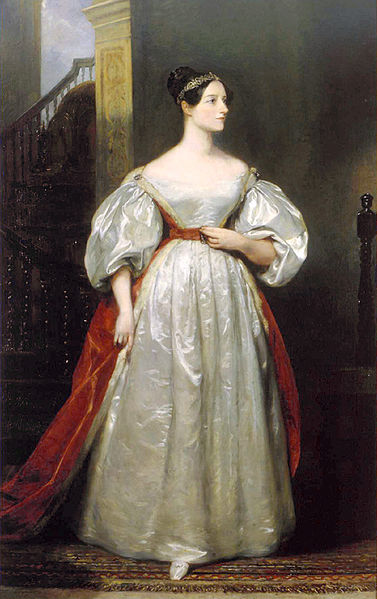
Today (Oct. 7) is Ada Lovelace Day, in commemoration of the 19th-Century British mathematician who collaborated with Charles Babbage to create the early mechanical computer the Analytical Engine by writing algorithms. Because of this she is often called the first ‘computer programmer’. This Day aims to raise of the profile of women in science, technology, engineering and maths, who are still underrepresented in these professions.
Here is Ada, Countess of Lovelace painted in 1836 by Margaret Carpenter (1793-1872). The painting belongs to the British government and is currently located at the #10 Downing Street residence in London.
AND read Sydney Padua’s highly irregular , wild and wonderful webcomic about Ada’s life & times. This series has been running for over 2 years and has been hailed one of the best webcomics on the net. The amount of effort and artistry that goes into this work is truly inspiring.
Ada Lovelace Day is about giving heroines the credit they deserve, so why not visit the site FindingAda and share your story about a woman whether an engineer, a scientist, a technologist or mathematician who has inspired you to become who you are today. I’m nominating Prof. Jane Plant, one of Britain’s most eminent scientists, who offered scientific proof of dairy-free diets as a cure and prevention for breast cancer. Her first book Your Life in Your Hands was groundbreaking, daring as it did to challenge the status quo. I cannot recommend this book (and her subsequent ones) highly enough, particularly if you have a history of this hideous disease in your family. It changed the way I eat and gave me hope for a future free from disease