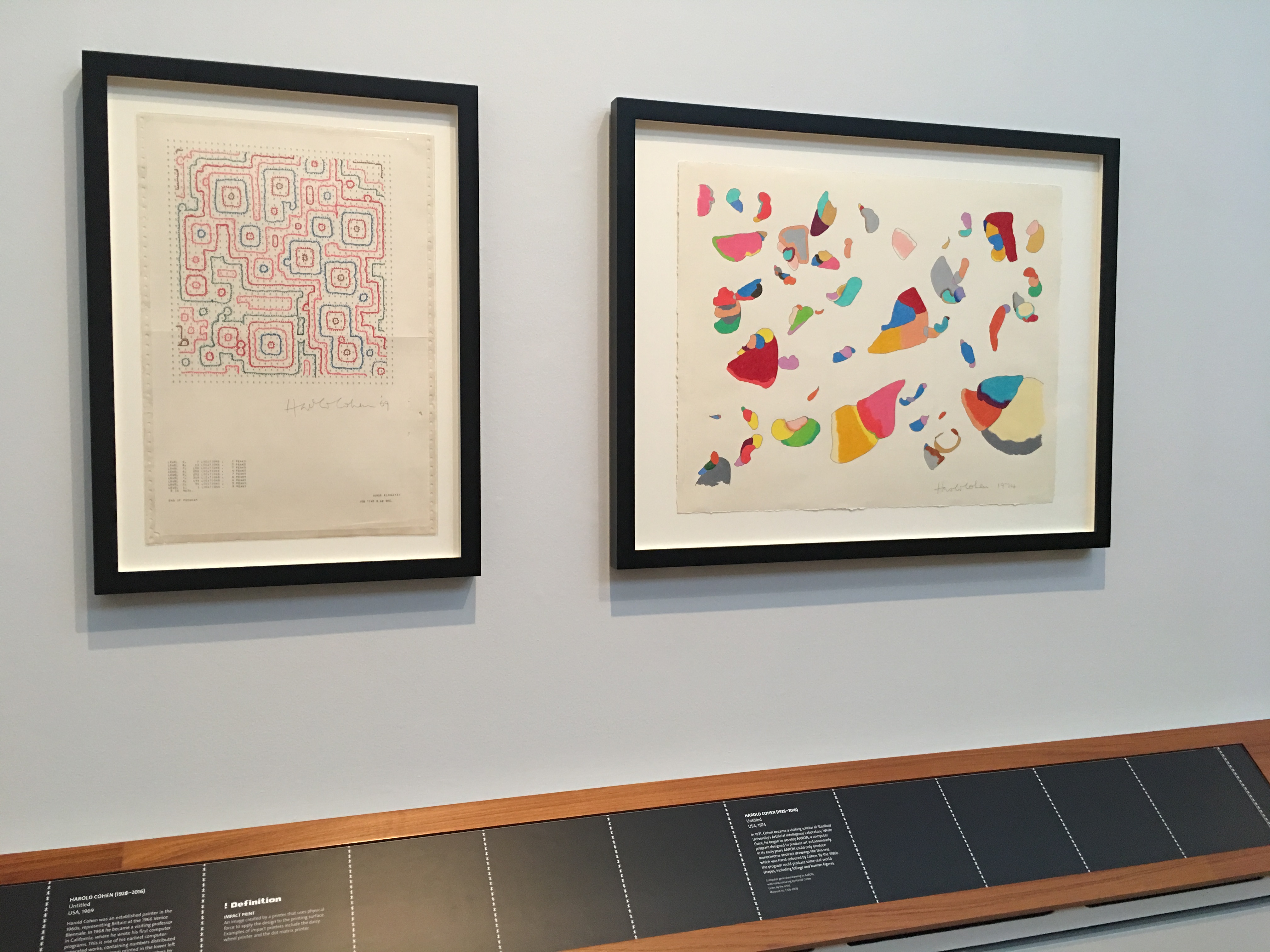
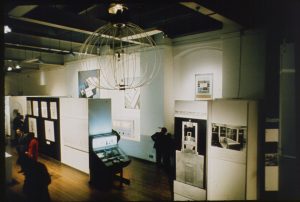
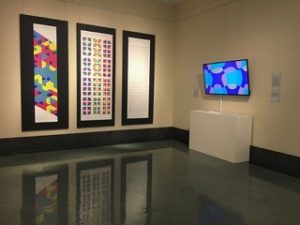
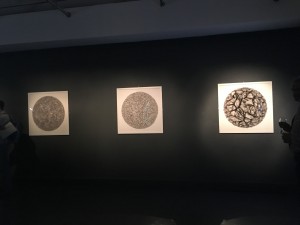
Installation view of Chance and Control at the V&A, showing early and mid-period drawings by Harold Cohen
Read my review in Studio International of the new display of computer art at the Victoria & Albert Museum London – Chance and Control: Art in the age of Computers and learn of the remarkable diversity of the V&A’s collection and how it has grown from early beginnings in just ten years. Among many things of interest here are three fabulous works by Harold Cohen from his early, mid and later period. Exhibition on now until 18 November 2018.
The computer, like any tool or machine, extends human capabilities. But it is unique in that it extends the power of the mind as well as the hand. Robert Mallary, 1976
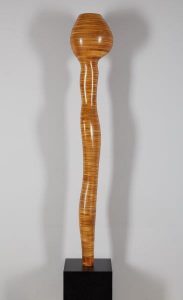
Robert Mallary, QUAD III, laminated plywood, 1969 courtesy the Mayor Gallery
I was inspired by the above quote from American pioneer of computer arts, Robert Mallary (1917-1997), whose work will be on view in the show from 6 June, along with drawings by Vera Molnar and Waldemar Cordeiro. The fully illustrated catalogue can be purchased from the Gallery.
Fifty years on from Cybernetic Serendipity, the 1968 exhibition of computer art,Studio International remembers the impact and legacy of this seminal show. Read my article which looks at the history of the exhibition and how it has shaped digital art in the years since.
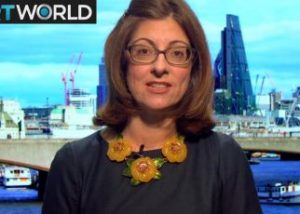
Thrilled to be a part of Showcase, the arts program on TRT World television on 14 November, with thanks to Belle Lupton. Watch me again here, speaking about the effects of technology on art.
‘A huge space of endless predetermined possibilities’: Computer art and the influence of D’Arcy Thompson
On 8 November 6pm, I’m thrilled to be going to the D’Arcy Thompson Zoology Museum to talk about how the writing of code has been used to draw since digital computing technology became accessible to artists from the mid-1960s. This year is the 100th anniversary of D’Arcy W Thompson’s book On Growth and Form (1917) which had a formative influence on the pioneers of algorithmic art.
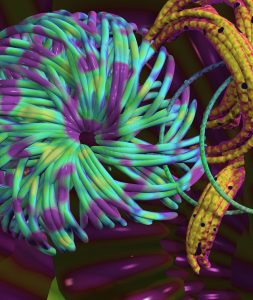
William Latham muta6, 2014 (detail)
In this talk we will learn how complex and visually arresting imagery often comes from surprisingly simple sets of instructions. We will discover that the use of the computer offers ‘a huge space of endless predetermined possibilities.’ (William Latham, artist)
Co-organised with the Abertay Historical Society as part of NEoN Digital Arts Festival supported by Creative Scotland. Book your ticket here
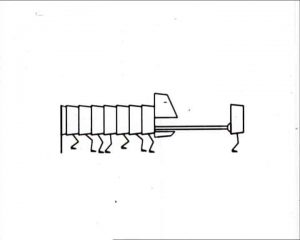
I was saddened to hear of the death of Tony Pritchett in August this year. For those who don’t know, Tony created The Flexipede in 1967, the first fully surviving work of computer animation created in Britain. I first met Tony in 2002 and he was always supportive of my research into the history of computer arts in Britain, never losing patience with my often limited grasp at that time of the technical aspects of the subject. I asked him how he came to create the Flexipede and why. After giving a detailed explanation, I then asked him who he had told this story to and where it was published, thinking I would look up some more aspects later. He replied that “no one has ever asked me before” ! This I found astonishing – the man who created the first British computer-generated animation should by rights be a household name nearly 30 years later. I feel enormously privileged to be one of the first to finally publish his story, which you can read in chapter 9 of The Computer in the Art Room.
Tony Prichett, still from The Flexipede, 1967
Tony loved filmmaking, often making recordings and videos of Computer Arts Society events, lectures and parties. I remember him filming me giving a speech at the book launch of The Computer in the Art Room at Somerset House in 2008. He was an early member of the CAS and could always be counted on for support and enthusiasm. It was typical of his kindness in supporting me at the Bits in Motion film screening I held at the NFT in 2006 (below). In addition to his computer arts activities, he told me he was interested in homeopathy and edited Positive News at one time. A very cultured and considerate gentleman, who will be greatly missed.
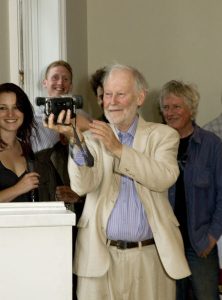
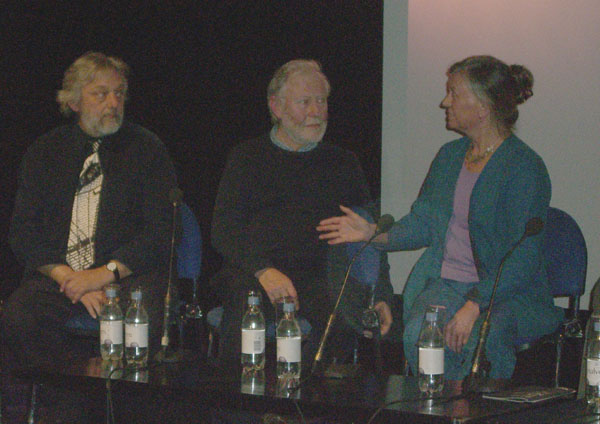
Malcolm LeGrice, Tony Pritchett & Nina Emmett, panel members at Bits in Motion, NFT 2006
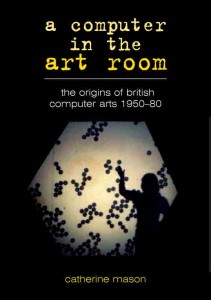
Just a reminder that my book – A Computer in the Art Room, The Origins of British Computer Arts 1950-1980 is still available to purchase from this website (it seems to be prohibitively expensive on Amazon for some reason) – click the SHOP tab above.
Andy Lomas Morphogenetic Creations, 2016 Installation view
Andy Lomas’s new solo exhibition at Watermans, (until 21st July) provides a perfect opportunity to see his complete vision. From framed prints and moving image animations to 3D printing, Lomas explores the aesthetics of biology inspired by the theories of Alan Turing and D’Arcy Wentworth Thompson. Based on his cellular growth model, he creates intriguing, uncannily beautiful shapes with the feel of living organisms. The quality of and detail in this work is superb, I urge everyone to see this wonderful show.